
The Battle For Your Mind
How to Stay Human in the Age of AI
Humans fuel data technology.
It quietly rewires our thoughts, emotions, and choices.
Discover how we arrived at this moment and what it means for our future.
The data we generate has become the most valuable resource on Earth, outpacing oil and gold in economic significance.
Yet most of us are unaware that we are participating in a global system that both monetizes our attention and programs our minds.
The Battle for Our Minds explores how we arrived at this moment and what it means for our future.
Written by Peter Zandan, Ph.D., a pioneer in data science and technology entrepreneurship, this book is both a personal reckoning and a societal warning.
Zandan draws on four decades of experience building data and AI companies -working with Apple, Microsoft, Intel, and hundreds of Fortune 500 firms - to uncover how today's digital systems don't just reflect human behavior, they shape it.
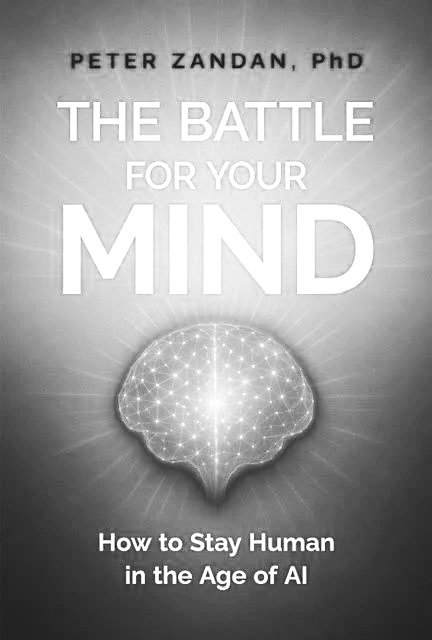
The book begins with the rise of the data economy, tracing how early analytics evolved into systems capable of anticipating and influencing our every move. Through vivid accounts from Silicon Valley boardrooms and tech labs to his own family's experiences, Zandan shows how this transformation happened not with a bang, but with a quiet, almost imperceptible shift in how we live.
Chapters delve into the addictive architecture of modern platforms, the monetization of our unconscious impulses, and the emergence of emotionally responsive algorithms that now serve as our comfort systems. Zandan reveals the moment at Apple's legendary advertising agency - when he realized data had stopped being a tool for truth and become ammunition for predetermined conclusions. He tracks the pattern as it repeated across industries until "strategic presentation" became standard practice.
What emerges is a portrait of a world where algorithms understand us better than we understand ourselves and use that knowledge to shape our identities, desires, and decisions. Zandan introduces the 70/30 Rule: systems can predict roughly 70% of our behavior, leaving a shrinking 30% - the "Surprise Zone" - where genuine human agency, creativity, and choice still operate.
But The Battle for Our Minds is not just an exposé, it's a call to action at both individual and institutional levels. Zandan offers practical frameworks for reclaiming agency in a world of algorithmic influence. Drawing on his own journey - from building prediction systems to the challenges in his own personal life - he shares what conscious partnership with technology actually looks like.
The book introduces "Mental Fitness" as a discipline for protecting cognitive independence. Unlike digital literacy (learning to use tools), Mental Fitness trains the capacities that make conscious choice possible: sustained attention, tolerance for uncertainty, deliberate decision-making, and the ability to override algorithmic suggestions when they conflict with human values.
Yet individual practices alone aren't enough. The book examines the widening governance gap: America invests over $400 billion annually in AI development while spending under $1 billion on ethics and safety. As AI capabilities advance in weeks while regulatory frameworks take years, democratic oversight falls perpetually behind.
Zandan explores both failures and successes in AI governance. While most institutions lag behind technological change, the book identifies exceptions - legislators who've insisted on hands-on technical experience before crafting policy, bipartisan efforts that prioritize both innovation and protection, and frameworks that balance economic competitiveness with democratic values. These examples demonstrate that informed governance is possible when policymakers engage directly with technology rather than relying solely on secondhand briefings.
Zandan doesn't advocate rejecting technology. Instead, he provides frameworks for strategic collaboration - using AI's strengths while protecting distinctly human capacities. He examines the four types of people navigating algorithmic life (Sleepwalkers, Neo-Romantics, Techno-Centrics, and Flourishers) and shows why 64% of Americans are drifting into dependency without realizing it.Citing experts like Shoshana Zuboff, Anna Lembke, and Sherry Turkle, Zandan challenges readers to develop a personal philosophy of engagement with technology. Not to reject it, but to choose consciously when and how it enters our lives.

The book also confronts what's at stake for the next generation. Today's children are the first raised without needing to navigate boredom, tolerate uncertainty, or make decisions without algorithmic assistance. Zandan examines which cognitive capacities atrophy when AI handles routine decision-making, and why this matters for democratic citizenship and human relationships.
Through personal stories - a plane conversation with a McKinsey consultant where he felt like a fraud despite his success, the hollow victory of going public in an airport lounge, the two houses that represent his life before and after awakening - Zandan adds an emotional spine to the analysis. This isn't abstract theory. It's lived experience from someone who built these systems, profited enormously, lost what mattered most, and learned the hard way what algorithms can and cannot measure.
This book is for readers who sense something has shifted in the way we think, act, and relate to one another and want to understand why. It's for technologists, educators, parents, policymakers, and anyone curious about the tradeoffs we've made for convenience, personalization, and digital comfort.
In the end, The Battle for Our Minds is about more than technology. It's about what it means to be human in a world where our thoughts are no longer entirely our own, how effective governance can protect human agency while enabling innovation, and how we might reclaim the best parts of ourselves before they're optimized out of existence.
The algorithm might predict most of your patterns. But in that crucial 30% where genuine choice still lives, you get to decide what those patterns mean.
Who is Peter Zandan?
Peter Zandan, Phd., is a data scientist, entrepreneur, and strategic advisor
whose career has bridged technology, human behavior, and storytelling.

As a pioneer in analytics and AI, he built companies and guided leaders at the forefront of global business and culture.
He founded IntelliQuest, one of the first large-scale analytics firms to go public on NASDAQ; created Zilliant, the Goldman Sachs–backed innovator in AI-driven pricing; and co-founded Quantified AI, recognized as one of the 50 fastest-growing AI companies in America.
As Global Vice Chair of Data Science at Hill+Knowlton Strategies, Zandan advised clients including Martha Stewart, Goldman Sachs, Dell, and the Olympic Games on trust, reputation, and the power of data to shape public perception. His insights and influence have been featured in The New York Times, The Wall Street Journal, and Harvard Business Review.
Named Entrepreneur of the Year by Ernst & Young in Austin and honored among Austin’s most influential business leaders, Zandan holds both a Ph.D. and MBA from the University of Texas, where he taught at the McCombs School of Business. He is deeply involved with the National Academy of Sciences in Washington, D.C., where his forthcoming book, The Battle for Your Mind: How to Stay Human in the Age of AI, will debut in early 2026.

With a unique blend of scientific credibility, entrepreneurial success, and cultural fluency, Peter Zandan stands out as a compelling media voice on how artificial intelligence is transforming attention, decision-making, and what it means to be human.